Personal Bankruptcy: Honest Review, Step-by-Step Guide, and Court Practice
When debts from bank loans, microloans, or utility bills become an unbearable burden, personal bankruptcy remains the only legal way to fully write off debt under Federal Law No. 127-FZ "On Insolvency (Bankruptcy)". However, many myths still surround this procedure: from "they will take away your only home" to "everything will be written off for 10,000 rubles in a couple of weeks."
In this article, without promotional slogans or legal fluff, we will break down how the bankruptcy process works, what actual expenses await you, how to retain your property and legally keep the living wage, as well as provide an interactive test to evaluate your chances.
Table of Contents:
- 1. Two Forms of Bankruptcy in Orel: Court vs MFC
- 2. Step-by-Step Judicial Bankruptcy Algorithm
- 3. Fast Cost Breakdown: Real Cost of Procedure
- 4. Property and Living Wage: What Will Be Seized and What Must Remain?
- 5. Court Practice and Risks of Debt Non-Discharge
- 6. Frequently Asked Questions (FAQ)
- 7. Interactive Test: Are You Ready for Bankruptcy?
1. Two Forms of Bankruptcy: Court vs MFC
Russian legislation provides for two ways to declare a citizen insolvent. The path choice depends on the total debt amount, active enforcement proceedings, and official income or assets.
| Parameter | Out-of-Court Bankruptcy (via MFC) | Judicial Bankruptcy (Arbitration Court) |
|---|---|---|
| Debt Amount | From 25,000 to 1,000,000 RUB | From 200,000 RUB (duty) / Up to 500,000 RUB (upon non-payment) |
| Cost | Free (no state duty or bankruptcy trustee fees) | From 130,000 to 180,000+ RUB (including mandatory expenses) |
| Timeline | Exactly 6 months | On average 6 to 12 months |
| Main Requirement | Terminated enforcement proceeding under Clause 4 Part 1 Art. 46 of FL No. 229 (or pensioner/allowance recipient status with no assets) | Signs of insolvency or insufficient property |
| Role of Financial Trustee | None | Mandatory participation (approved by the court) |
Important Expert Note: With the expansion of out-of-court bankruptcy criteria, pensioners and families with children whose only income consists of social benefits can now discharge debts via MFC 1 year after the start of forced recovery by bailiffs, without waiting years for cases to close under Art. 46.
2. Step-by-Step Judicial Bankruptcy Algorithm
If your case does not meet the criteria for the free procedure through MFC, the process goes through the Arbitration Court at your place of registration (Art. 33 FL No. 127-FZ).
#1
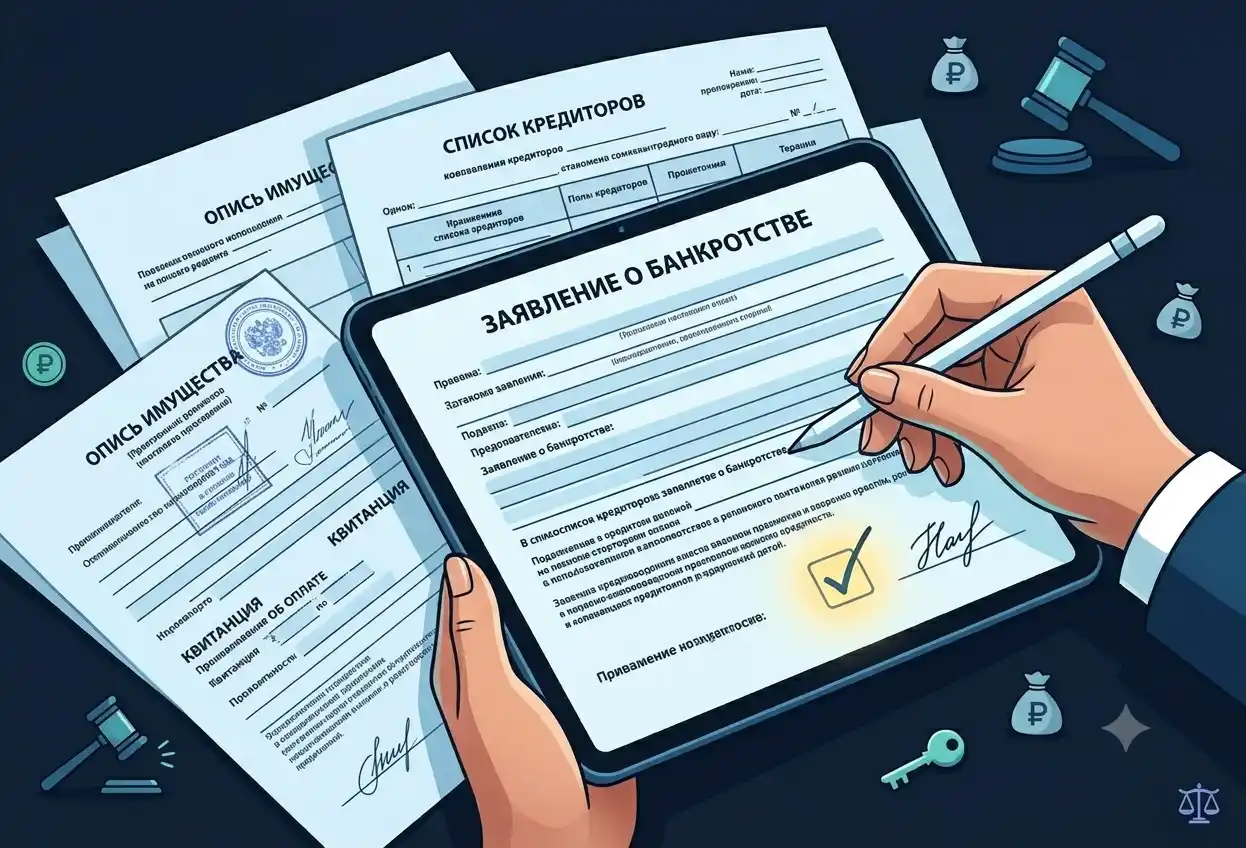
Collection of Documents
Personal documents (passport, SNILS, INN, marriage/children certificates), debt records (loan agreements, bank statements, credit history reports), and asset details for the past 3 years (EGRN property extracts, vehicle registration) are collected.
#2
Drafting Application and Paying Mandatory Fees
An application to the court is prepared, and a deposit for the trustee fee (25,000 RUB) is paid to the Arbitration Court account. The application must specify a Self-Regulatory Organization (SRO) from whose members the trustee will be appointed.
#3
First Court Hearing
The court examines the validity of the application. At this stage, one of two procedures is introduced: debt restructuring (extremely rare without high official income) or immediate asset liquidation.
#4
Asset Liquidation Procedure and Trustee Work
From this point on, all bank cards and accounts are handed over to the financial trustee. The trustee forms the bankruptcy estate, publishes notices in the EFRSB registry and Kommersant newspaper, analyzes transactions over the last 3 years, and conducts auctions (if there are assets to sell).
#5
Final Hearing and Complete Debt Discharge
The financial trustee submits the final report. The court ruling completes the asset liquidation procedure. The citizen is fully released from further performance of creditor claims (Art. 213.28 FL No. 127-FZ).
3. Real Cost of Procedure
Many legal firms advertise "turnkey bankruptcy for 30,000 rubles." This is misinformation. There are statutory mandatory expenses that cannot be avoided under any circumstances.
| Expense Item | Legal Basis / Details | Estimated Amount |
|---|---|---|
| Financial Trustee Fee | Court Deposit (Art. 20.6 FL No. 127) | 25,000 RUB (per single procedure) |
| EFRSB Publications | Mandatory registry notifications | ~7,000 – 10,000 RUB |
| Kommersant Newspaper Notice | Strictly according to publisher rate | ~12,000 – 15,000 RUB |
| Postal and Administrative | Notifying creditors via registered letters | ~3,000 – 5,000 RUB |
| Legal / Attorney Fees | Support, contract drafting, court defense | from 80,000 to 140,000 RUB |
| TOTAL (basic minimum): | --- | from 130,000 to 195,000 RUB |
4. Property and Living Wage: What Will Be Seized and What Must Remain?
The fear of losing everything is the main barrier for citizens. The law provides clear immunity for specific property categories in accordance with Art. 446 of the Civil Procedure Code of the Russian Federation (CPC RF).
Property exempt from seizure and sale:
- Only primary residence (apartment, house, room) and the underlying land plot, provided it is not mortgaged/pledged (see full article: Will the sole residence and machinery in the event of bankruptcy?).
- Ordinary household items, personal effects (clothing, footwear).
- Equipment/tools required for professional work (valued up to 10,000 RUB).
- Food products and money equal to the living minimum allowance for the debtor and their dependents.
- State awards, commemorative and honorary badges.
- Vehicles and equipment necessary for a disabled debtor.
Legal Nuances: How to exempt additional funds from the bankruptcy estate?
Under Art. 213.25 FL No. 127-FZ and Ruling No. 48 of the Plenum of the Supreme Court of the Russian Federation, the trustee must allocate the regional living wage monthly. However, if you require regular funds for vital medication, rent payments (if you own no housing), or children's tuition, you have the right to petition the Arbitration Court to exempt additional amounts above the living wage.
5. Court Practice and Risks of Debt Non-Discharge
It is crucial to remember: bankruptcy is not automatic debt forgiveness. Article 213.28 (Part 4) of FL No. 127-FZ defines cases when the court refuses to discharge debt:
- Providing false information: The citizen submitted false income records when applying for loans or hid assets from the financial trustee.
- Illegal acts in bankruptcy: Attempting to hide, destroy, or transfer assets to third parties prior to proceedings.
- Fictitious or intentional bankruptcy: Signs of artificially creating insolvency (Art. 195, 197 Criminal Code of the RF).
- Intentional evasion of payment: An effective court sentence for credit fraud.
Debts that CANNOT be discharged under any conditions:
- Child support / Alimony obligations.
- Claims for compensation for harm caused to life or health.
- Unpaid employee wages and severance pay (for former sole proprietors).
- Moral damage and damages caused intentionally or by gross negligence.
- Subsidiary liability of controlling persons.
6. Frequently Asked Questions (FAQ)
Question 1. Will my only primary residence be seized during judicial bankruptcy?
No, under Art. 446 of the CPC RF, the only primary residence and the land beneath it have enforcement immunity. The exception is mortgaged or pledged real estate — such property becomes part of the bankruptcy estate and is subject to liquidation.
Question 2. Can I complete out-of-court bankruptcy via MFC for free if my debt exceeds 1,000,000 RUB?
No. Out-of-court bankruptcy via MFC is strictly limited to amounts from 25,000 to 1,000,000 RUB. If total debt exceeds 1 million rubles, discharge is only possible through the Arbitration Court.
Question 3. What will I live on during judicial bankruptcy proceedings?
Throughout the asset liquidation procedure, the financial trustee is required to pay you a monthly amount equal to the regional living minimum for yourself and your dependents. Furthermore, you can request court permission to exclude extra funds for vital medication, rent, or tuition fees.
Question 4. Are alimony or personal injury debts discharged?
No, these debt categories cannot be written off under any circumstances (Parts 5 and 6 of Art. 213.28 FL No. 127-FZ). Salary arrears to former employees, moral damages, and subsidiary liabilities are also non-dischargeable.
Question 5. What happens to vehicle or real estate sales made before declaring bankruptcy?
The financial trustee and creditors analyze all transactions executed by the debtor within the last 3 years. Gift transfers or sales to relatives below market value will be challenged in court, and the assets will be returned to the bankruptcy estate.
7. Interactive Test: Are You Eligible for Bankruptcy?
Answer 4 simple questions to understand in 1 minute which bankruptcy format suits you best and if there are any risks involved.
Question 1 of 4: What is your total debt amount (loans, microloans, utilities, taxes)?
Express Analysis Results:
Expert Recommendation: Book a free consultation with an attorney to build a safe strategy for writing off your debts.